 English
- Home
- About Company
- Our Products
- Brochure
- Gallery
- Contact US
Graphite Reactor
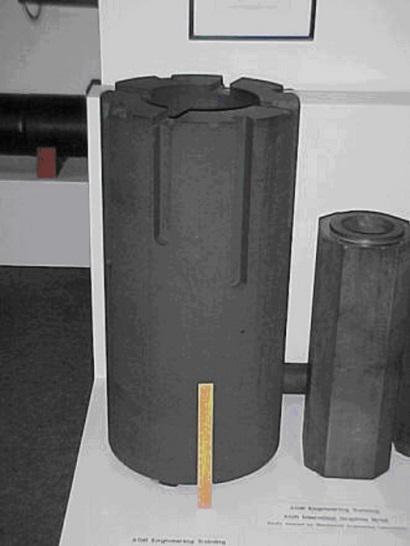
A graphite reactor is a type of nuclear reactor that utilizes graphite as a moderator, and sometimes also as a reflector and structural material. Graphite, due to its ability to slow down neutrons without absorbing them, allows for the use of natural uranium fuel, which is less enriched than in other reactor types. These reactors have been used for both plutonium production and electricity generation.
Key Features and Components:
-
Graphite Moderator:
The core of a graphite reactor is typically a large block of graphite, which acts as a moderator, slowing down neutrons produced during nuclear fission to sustain the chain reaction.
-
Fuel:
Graphite reactors can utilize natural uranium or low-enriched uranium as fuel.
-
Coolant:
Coolants like gas (e.g., CO2) or water can be used to remove heat from the reactor core.
-
Control Rods:
Graphite reactors also employ control rods, often made of boron or other neutron-absorbing materials, to regulate the rate of the nuclear reaction.
-
Reflector:
Graphite's ability to reflect neutrons back into the core can also enhance the reactor's efficiency.
Types of Graphite Reactors:
-
Light Water Graphite Reactor:
A hybrid design that combines features of other reactor types, using light water as a coolant and graphite as a moderator.
-
Advanced Gas-cooled Reactor (AGR):
Uses graphite as a moderator and CO2 as a coolant.
-
RBMK Reactor:
A Soviet-designed reactor type using graphite as a moderator and boiling light water as a coolant.
-
Sodium Graphite Reactor:
Utilizes sodium as a coolant, allowing for higher operating temperatures and potentially increased efficiency.
Historical Significance:
- The X-10 Graphite Reactor at Oak Ridge National Laboratory was the first nuclear reactor designed for continuous operation and played a crucial role in the development of plutonium production and research.
- Graphite reactors have been used to produce isotopes for various scientific, medical, and industrial applications.